Book a Demo →

BAD BURRITO STUDIOS

Studio Intelligence for Film & Television Production

Founded by Dave Wilson • Bad Burrito Productions Inc.

Meet the Founder
Meet the Founder
Dave Wilson • Founder / Producer / Editor
25 years in film and television production, from network television to branded content to independent film. Built production workflows from the inside, saw firsthand how much time and money is wasted on manual processes that haven’t changed in decades, and decided to build what should have existed years ago. The Voice (NBC) • Producer / Editor The Voice on Snapchat • 40M+ views ESPN • McEnroe vs. McEnroe • Editor MTV, A&E, Amazon • Editor 3x Clio Award Winner Boy Scout. Private pilot. Open Water II diver. Caribbean sailor. The same instinct shows up in everything he takes on: learn the system completely, go all the way in, and don’t stop until it works. Bad Burrito Studios isn’t a tech company guessing at production workflows. Every feature exists because we’ve lived the pain it solves.
“The industry runs on spreadsheets and software from the ’90s. We built what should have existed years ago.”
The Problem
Before cameras roll on any film or TV project, a production team spends weeks manually reading scripts, cataloging every prop, costume, vehicle, and location, building budgets in spreadsheets, and constructing shooting schedules by hand. This process costs tens of thousands of dollars in payroll before a single frame is shot. The tools that exist are decades old, desktop-only, and built for a pre-cloud world and can't understand a screenplay, let alone act on it.
The Cost of Manual Prep

Every production in Hollywood goes through this process. Most of them still do it by hand.

Production Coordinator
$4,800+
$800/wk for 4-6 weeks of script breakdown
Line Producer / UPM
$15,000+
$2,500-$5,000/wk for 4-6 weeks of budgeting
1st Assistant Director
$12,000+
$2,000-$3,000/wk for 4-6 weeks of scheduling
Call Sheets
45 min/day
Built manually, every single shoot day
Total Pre-Production Labor
$30,000+
Before cameras ever roll
Tools Replaced
5-7
Spreadsheets, legacy software, email
The Solution
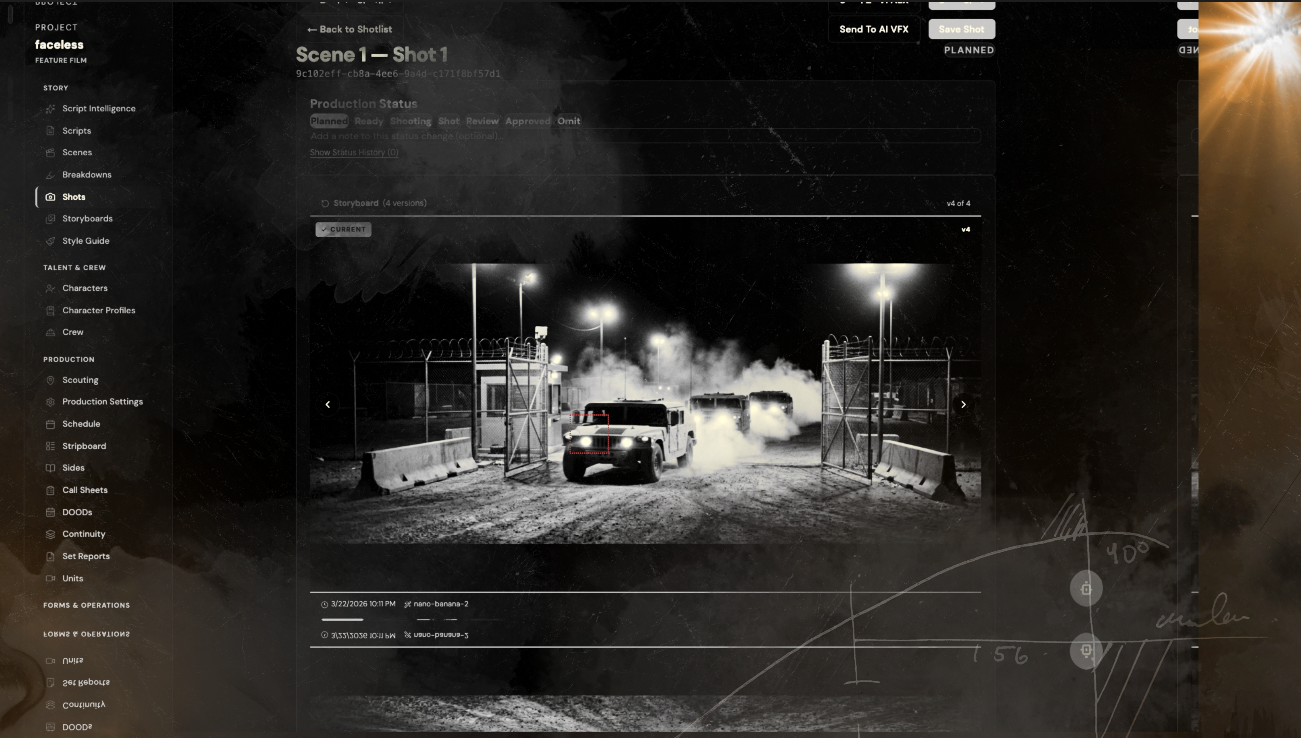
Bad Burrito Studios replaces the most time-consuming and error-prone phase of production with Studio Intelligence, the production engine we built in-house. Upload a screenplay and the entire pre-production pipeline fires automatically: scene breakdowns across 22 categories, a 14-category line-item budget with union compliance, a shooting schedule with turnaround rules and company moves, shot lists with camera plans, and Studio Intelligence-generated storyboards. One script. Everything generated. For a fraction of the payroll.
What We've Built

This is not a prototype. It is a fully functional production management platform built on enterprise infrastructure, currently in use on active projects. Every time a user adjusts a budget estimate, accepts a schedule suggestion, or overrides a Studio Intelligence recommendation, the platform learns. Confidence scores adapt, future estimates improve, and the system gets smarter with every production that runs through it.

Production Tools
140+
Fully functional, not a prototype
API Endpoints
200+
Enterprise-grade backend
Studio Intelligence Modules
40+
Breakdown, budget, schedule, storyboards, VFX, rights, payroll
Database Tables
75+
Multi-tenant with Row-Level Security
Union Coverage
SAG-AFTRA, DGA, WGA
Residuals formulas + payroll remittance reporting
Payroll Integration
Check by Intuit
Verified API, workplace + worker sync, run approval
Core Capabilities
Script Ops — Studio Intelligence breaks down every scene across 22 production categories in minutes
Production Budget Hub — The full budget lifecycle in one place: AI Estimate → Producer Review → Locked Budget → In Production → Post-Production → Wrapped → Final Cost Report. Every dollar is traceable from estimate to close. Nine integrated sub-modules: Production Readiness Gate, Predictive Hot Costs, Weekly Cost Report generator, Timecard Reconciliation, Actuals & Commitments ledger, Scenario Lab, Incentive & Tax Credit tracking, Role-Based Dashboards, and Wrap Checklist.
Role-Based Dashboards — Six focused production views: Producer (budget health, approvals, readiness), UPM (hot costs, schedule impact, reconciliation), Production Accountant (actuals, POs, cost reports), Assistant Director (call sheets, DPR, payroll flags), Department Head (their budget and POs), Post Supervisor (post pipeline, deliverables, wrap).
Schedule — Union-compliant stripboard with turnaround rules, company moves, and location grouping
Call Sheets — Auto-generated, emailed with PDF to every crew member, one click
Shot Lists & Storyboards — Camera plans with lens and movement specs, visual boards generated by Studio Intelligence
Video Review — Frame-accurate timecoded annotations with multi-step approval workflows
On-Set Reports — Script supervisor, camera, and sound reports from mobile devices
Crew & Payroll Management — Integrated payroll runs via Check by Intuit with union intake, workplace mapping, SAG-AFTRA and MPEG remittance reporting, and pay-run preview and approval
Contracts & Rights — Upload any contract as PDF. Studio Intelligence extracts residuals, license windows, distribution grants, chain of title, credit, exclusivity, and morals clauses with verbatim source quotes and page anchors
Residuals & Rights Forecast — Project residual liability by year, quarterly payment calendar, and music license renewal spend from the extracted clauses. Real financial planning from documents most studios bury in a shoebox
Distribution Management — Track distribution grants by territory and media, exclusivity windows, holdbacks, minimum guarantees, and chain-of-title gaps in a project-level Rights Dashboard
Post-Production Handoff — All production data in one place for editorial, plus structured rights data for business affairs and legal

Budget & Schedule Generation

Production Budget Hub

Budget Hub does more than approved budget versus actuals. It keeps the production ledger, payroll risk, cost reports, forecast, and wrap close-out in the same operating loop, so producers can see where the budget stands, why it moved, and what action changes the outcome.

Lifecycle Stages
7
AI Estimate → Producer Review → Locked → In Production → Post → Wrapped → Final Cost Report
Sub-Modules
9
Readiness gate, predictive hot costs, cost reports, reconciliation, actuals, scenario lab, incentives, role dashboards, wrap
Budget Intelligence
5 Surfaces
Predicted EFC, risk signals, proactive alerts, category flex, variance narrative
Internal Actual Sync
3 Sources
POs, petty cash, and timecards create, update, or retire linked ledger rows continuously
Payroll Risk Flags
9 Types
Meal penalties, forced calls, turnaround violations, sixth/seventh day, missing timecards, OT risk, union thresholds
Scenario Lab
Cascading
Location moves, cover days, equipment changes, labor deltas, meal penalties, and turnaround impacts
Audit Trail
Line-Level
Locked values, source references, changed-since-lock indicators, and report snapshots stay attached
From Variance Reports to Budget Intelligence
A traditional variance report answers one narrow question: what did we budget, what did we spend, and what is the difference? Bad Burrito Studios turns that static report into an operating system for production finance.
The Budget Hub continuously connects the budget to the work that is actually creating cost: purchase orders, petty cash, submitted/approved/paid timecards, CSV transaction imports, payroll flags, commitments, weekly cost reports, and scenario decisions. Those source records feed Hot Costs, predicted final cost, confidence scoring, proactive alerts, and variance narratives, so producers see not only that the budget moved, but which production event moved it. Instead of making the accountant explain why an account is red after the fact, Bad Burrito shows the chain of cause and effect: the PO that became a commitment, the timecards that pushed labor into overtime, the petty cash envelope that reconciled into actual spend, the unresolved payroll flag, the department exposure, and the scenario that could change the outcome. The result is budget control in production language: traceable source records, forecasted exposure, recommended actions, and cost reports that carry the story forward week by week.
Movie Magic Shows What Happened. Bad Burrito Predicts What Happens Next.

The difference is timing. A static report documents the overage. Budget Intelligence gives the producer a forecast, confidence level, source trail, and action path while there is still time to change the outcome.

Static Variance
After
Traditional reports compare approved budget against posted actuals after the spend is already visible
Predicted EFC
Before
Bad Burrito forecasts estimated final cost from actuals, commitments, payroll exposure, and risk signals
Confidence Score
Visible
Forecast confidence tells producers when the model needs more source data before acting
Risk Exposure
Live
Pending POs, payroll flags, petty cash, and open commitments stay in the operating picture
Source Links
Traceable
Every synced row points back to the PO, envelope, timecard, import, or signal that created the exposure
Threshold Alerts
Proactive
Alerts surface before overages turn into cost-report surprises
Actuals & Commitments Stay Current

The Budget Hub now has a current internal ingestion loop. Production accounting can still review the ledger, but source-linked records stay connected to the operational systems that created them.

Purchase Orders
Synced
Active POs become commitments; received POs become approved actuals; cancelled POs retire
Petty Cash
Synced
Open spend stays pending; reconciled envelopes become approved actuals
Timecards
Synced
Submitted, approved, and paid timecards flow into payroll actuals with crew rates and penalties
CSV Imports
Review Queue
Card exports and accounting files are deduped, fingerprinted, and matched to budget accounts
Refresh Paths
3
Sync Internal button, weekly cost report generation, and scheduled budget-intelligence refresh
Duplicate Control
Source Linked
Rows keep source references, so repeated syncs update the same ledger record instead of duplicating spend
Predictive Hot Costs

Hot Costs becomes the daily control room: not just what was spent, but what the production is likely to finish at and which source records are driving the forecast.

Estimated Final Cost
Live
Forecast uses approved budget, actuals, commitments, payroll exposure, and production risk signals
Risk Signals
Auto-Detected
Over-budget accounts, unmapped POs, petty cash gaps, overtime patterns, and payroll exposure
Proactive Alerts
Actionable
Thresholds warn producers before risk turns into a cost-report surprise
Category Flex
Suggested
Related underruns and overruns surface as reallocation opportunities
Variance Story
Narrative
The system explains the cost movement in production terms, not just percentages
Confidence
Scored
Forecasts carry confidence so producers know when more source data is needed
Variance Storytelling
Instead of saying Locations is 15% over, Bad Burrito explains the production event that caused the variance: meal penalties, overtime, company moves, rain cover entered by the team, PO exposure, petty cash drift, or unresolved payroll flags. The goal is not a prettier spreadsheet. It is a cost story a producer, UPM, and accountant can act on in the same meeting.
Scenario Lab

Producers can ask budget questions the way production actually works: What happens if we move the warehouse scene, add a weather cover day, or swap the equipment package? The answer includes the downstream budget impact, not just one isolated line item.

Move Location
Modeled
Crew travel, equipment moves, company moves, and location deltas are recalculated together
Add Cover Days
Modeled
Labor days, rental extensions, and location costs roll into one projected delta
Change Equipment
Modeled
Camera, grip, electric, and department-specific rental changes hit the right accounts
Labor Effects
Included
Overtime, meal penalties, turnaround exposure, and payroll flags feed the impact model
Account Impacts
Line-Level
Scenario deltas map back to budget accounts instead of living in a separate spreadsheet
Decision Record
Saved
Scenarios and impact rows are stored for producer review and cost-report context
Weekly Cost Reports With Intelligence

The weekly cost report becomes more than an accounting snapshot. It carries the forecast, confidence, drivers, and story that explain what changed since the last report.

Predicted Final Cost
Included
Each report can store the current EFC alongside actuals and commitments
Prediction Confidence
Included
Confidence is saved with the report so producers know how much to trust the forecast
Variance Narrative
Included
The report captures the production-language explanation, not just account percentages
Predictive Drivers
Included
Drivers are stored as structured data for review and follow-up
Source Sync
Before Save
Cost-report generation refreshes internal actuals before calculating the report
Approval Context
Ready
Producer and accountant review happens on a report that already includes forecast context

Shot Lists, Storyboards & Temp VFX

Getting Started & Studio Intelligence Assistant

On-Set Production & Post Handoff

Case Study: The Bloody Benders
Format
10-Episode Series
Period western — scripted drama
Script
120 Pages
27 scenes, full season arc
Breakdown Time
20 Minutes
Was 8–13 weeks of manual prep
Elements Identified
696
Props, costumes, locations, VFX — all 22 categories
Camera Shots Generated
372
Lens specs, movement, and coverage
Pre-Production Labor Saved
$30,000+
Coordinator, Line Producer, 1st AD
Case Study: Faceless
Format
Feature Film
Contemporary action thriller
Scenes Analyzed
116
Large ensemble cast
Elements Detected
696
Across all 22 breakdown categories
Shots Generated
372
Full shot list with camera specs
Cast Identified
24 Members
With character and scene breakdowns
Wardrobe Dupes Resolved
13
Costume dedup engine — auto-merged
Before vs. After

Before: tens of thousands in pre-production payroll. After Bad Burrito Studios: script to schedule in minutes. On top of that, crew payroll fees, residuals admin, music clearance tracking, and chain-of-title legal all come out of the same platform — another $30K-$70K in back-end admin that most productions pay to separate vendors. Bundled in one system, it is a total project swing of $60K-$140K+ in eliminated labor and fees.

Script Breakdown
20 min
Was 40-60 hours
Budget
Minutes
Was 2-4 weeks
Schedule
Automatic
Was 2-3 weeks
Storyboards
1 hour
Was 3+ days
Call Sheets
1 click
Was 45 min per day
Weekly Cost Report
Auto-generated
Was manually assembled spreadsheet — hours of accountant time per week
Budget Audit Trail
Line-level
Was nothing — no record of what changed after the budget was signed
Payroll Saved
$30,000+
Per production in labor
Payroll Service Fees
$10K-$15K
On $2M below-the-line. Legacy services charge 0.4-0.6% of gross payroll
Residuals Admin
$2K-$8K/yr
Legacy services charge 0.35-0.5% of residual pool to administer
Music Clearance Admin
$5K-$12K
Per project, to manage sync windows and renewal cycles
Chain-of-Title Legal
$15K-$35K
E&O insurance compliance packages at back-end of a feature
The Cost of Post-Production Admin

Most platforms stop at the wrap party. Bad Burrito Studios follows the money all the way through exploitation. Producers see exactly what they owe, to whom, and when — with the clause text and page reference right there for their attorney to verify.

Paymaster Salary
$1,200-$2,000/wk
Replaced by one-click payroll runs through Check by Intuit
Residuals Tracking Software
$200-$2,000/mo
Standalone tools (RoyaltyHub, Compeat) rolled into Bad Burrito
Distribution Rights Admin
Hours/wk
Spreadsheet reconciliation eliminated by the Rights Dashboard
Missed Renewals
$0
Automatic alerts 90 days before every license window and residual due date
Rights Forecast
Built-in
Projected residuals by year + quarterly cash-out calendar
Back-end Savings
$30K-$70K
Per feature, on top of pre-production savings
Why Now
Studios and networks are managing larger slates with tighter margins than ever before. Global content production spending exceeded $250B in 2025, but the tools running pre-production haven’t changed in decades. Movie Magic Budgeting and Scheduling have dominated this space for 25+ years without meaningful innovation. They’re desktop-only, siloed, and built for a world before cloud collaboration, before remote production, and before AI. Meanwhile, every major studio is under pressure to produce more content, faster, with fewer overhead dollars. The post-strike landscape has compressed timelines and budgets simultaneously. Until recently, no system could reliably read a screenplay and understand dramatic context, character relationships, and production logistics at the same time. That capability arrived in 2024. Studio Intelligence is the first production engine built on top of it. The studios that adopt intelligent production tools will outpace the ones still running 1990s software. The window to own this category is now.
“Dark, cinematic, professional. Built by a filmmaker, not a design agency.”
Primary Market — Studios & Networks
Slate Size
10–50+
Productions per year requiring standardized, scalable workflows
Budget Range
$1M–$50M+
Features and series where pre-production efficiency hits the bottom line
Decision Makers
Line Producers & UPMs
Responsible for delivering on time and on budget
Pain Point
$30,000+
Pre-production labor cost before cameras roll — per project
Target Networks
Netflix · A24 · FX · Amazon · HBO
And their production company partners
Opportunity
$250B+
Global content production spend in 2025
Secondary Market — Commercial & Branded Content
Commercial production companies — high-volume, fast-turnaround projects at scale
Branded content studios — agency-adjacent producers delivering 20–100+ spots per year
Mid-tier production companies scaling from 3–5 projects to 10+ and hitting the limits of manual process
Film schools and training programs standardizing on industry-grade production tools
Other Work: TRL/Active
AI-powered personal fitness coaching platform. Real-time voice coaching during workouts using GPT-4o Realtime API with bidirectional streaming audio. Personalized multi-week workout programming, adaptive progression, and nutrition guidance with automated meal plans. Live on iOS (App Store), Android (Kotlin/Jetpack Compose), Apple Watch, and web. 155 serverless edge functions, per-user AI cost tracking, trainer portal for B2B2C distribution. Custom low-latency audio pipeline (RemoteIO AudioUnit with lock-free ring buffer) for real-time voice coaching playback.
Other Work: OrgHub & Member Portals
Open-source, multi-tenant member portal platform for nonprofit organizations. Lodges, cultural societies, service clubs, and community organizations each get their own branded portal with events, committees, messaging, newsletters, volunteer management, document library, membership billing (Stripe), and an AI assistant. Currently powering the Pasadena Elks Lodge 672 (88+ database migrations, 60+ API endpoints, Coral Room dining reservations, duty officer scheduling) and the Garibaldina Society. Built on Next.js, Supabase with Row-Level Security, and Turborepo monorepo architecture.
Enterprise Security & Compliance

Built for studios that require SOC 2 readiness, DMARC-enforced email, Content Security Policy headers, SSRF protection, and rate limiting on every endpoint. Production data never leaves the platform without authorization.

Data Isolation
RLS
Row-Level Security on every table. Complete tenant isolation at the database level.
Access Control
RBAC
5 permission levels: Admin, Producer, Editor, Crew, Viewer
Audit Logging
Full
Every action tracked with user, timestamp, and change history
Authentication
SSO
Single Sign-On, OAuth, MFA-ready. Enterprise identity provider integration.
Encryption
AES-256
Data encrypted at rest and in transit. TLS 1.3 enforced.
Uptime
99.9%
Global CDN, automated failover, real-time monitoring
Service Level Guarantees
Dedicated infrastructure for enterprise customers with isolated database instances
Point-in-time recovery with continuous WAL archiving and 7-day restore window
Real-time monitoring dashboard with uptime grid, error budgets, and API activity tracking
Role-based access control with per-project crew permissions and org-level management
Automated backup verification with quarterly restore testing
DMARC, SPF, and DKIM email authentication enforced on all outbound communications
Content Security Policy, CORS, and SSRF protection on every route
Vendor policy layer wrapping every external model call with audit logging and deny/redact rules
“Every major production will run on an intelligent pre-production system within 5 years. The question is whether they’ll use a purpose-built platform made by filmmakers, or cobble it together from generic tools. Studio Intelligence is the purpose-built answer.”
LET’S TALK

Bad Burrito Studios is live at badburrito.com. The platform is in active use on real film and television productions. We’re looking for strategic partners and investors who understand the entertainment industry and want to be part of the shift to Studio Intelligence-powered production.

Contact [email protected]
Platform Demo
▶Open Platform Overview — 1920×1080 Demo
Opens in a new window · designed for projector or external display
© 2024–2026 Bad Burrito Productions Inc.